Summary
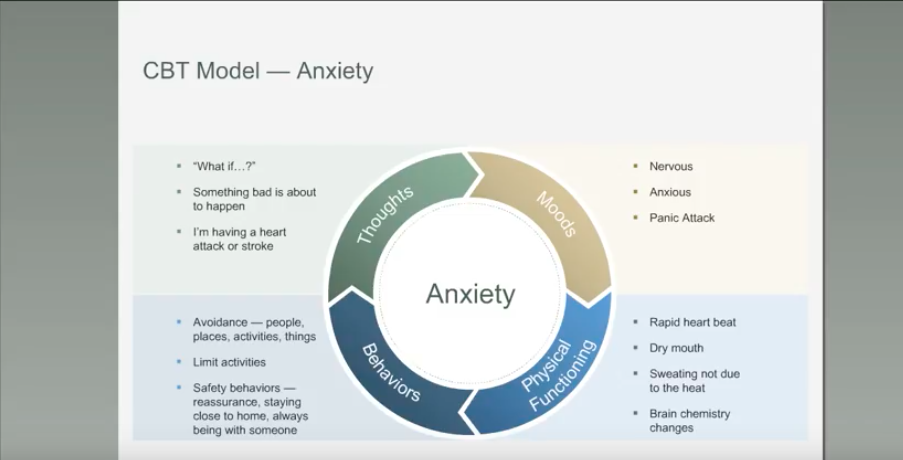
Dennis Greenberger, PhD, addresses the differences and similarities between symptoms of anxiety and depression, how the disorders are treated with CBT, and what patients can expect in treatment.
About
How CBT works for Anxiety and Depression
This webinar is an educational presentation, offered by the ADAA (Anxiety & Depression Association of America). Click on the arrow in the picture below to start the video.
Distorted Negative Automatic Thoughts (NATs)
The following is a list of the most common ways we tend to distort reality … when we’re feeling anxious or depressed. Try to pay attention – whenever you feel too anxious or too sad – to each thought and use the list to categorize. That’s the first step toward managing negative feelings better. Also, beware, not EVERY negative automatic thought is a distorted one. And, that’s helpful to realize which thoughts are and which are not distorted.
Common Distorted NATs
- All or Nothing: A situation is ABSOLUTE and EXTREME; it’s black & white only. Example: If it’s not perfect, I failed.
- Discount Positives: Your positive experiences, deeds, or qualities don’t count (or you magnify negatives). Example: I did that well, but that doesn’t mean I’m good at it.
- Emotional Reasoning: Conclude it’s true when it feels true (ignoring facts). Example: I feel like it was all my fault, so it was all my fault.
- .Labels: Label yourself (or others) globally. Examples: I’m a loser … He’s a jerk
- Jump to Conclusions: Not considering other explanations, you…(1) Fortune-Tell: It’s going to be a bad day. (2) Mind-Read: He thinks I’m not doing a good job. (3) Personalize: It’s all my fault. (4) Catastrophize (worst case scenario): This spot on me is cancer!!
- Tyrannical SHOULDs: Use ‘all or nothing thinking’ when you apply a RULE (to yourself or others) as if it’s the ONLY way, & overestimate how bad it is when your expectations are unmet. Examples: I gotta’ get this done today. He shouldn’t say that.
- Overgeneralize: Spread out a negative experience. Examples: It was a bad day…bad month…bad year. A black cloud follows me all over.
More Resources
For more information about each of the Anxiety Disorders, I recommend the Association for Behavioral & Cognitive Therapies (ABCT) excellent CBT ‘Fact Sheets’ :
- Panic Disorder
- Social Phobia
- Generalized Anxiety Disorder (GAD)
- Specific Phobias
- Obsessive Compulsive Disorder (OCD)
- Post Traumatic Stress Disorder (PTSD)
I highly recommend the CBT Fact Sheet for Depression as well.